A hob is a precision appliance: glass, electronics and gas packed into a few centimeters inside your counter. Our technicians specialize in every technology — from the gas thermocouple to induction coils — and we have one fixed rule: a safety sensor gets repaired or replaced, never bypassed. Free inspection and a written warranty up to one year.
A hob is a precision appliance in every sense: within a few centimeters of thickness sit burners or heating coils, above an electronic board, above gas or electrical connections — all embedded in a counter. There is no room for rough work: a screwdriver in the wrong spot under the glass creates a new crack, and a rushed connection leaves a leak trapped under the marble.
2
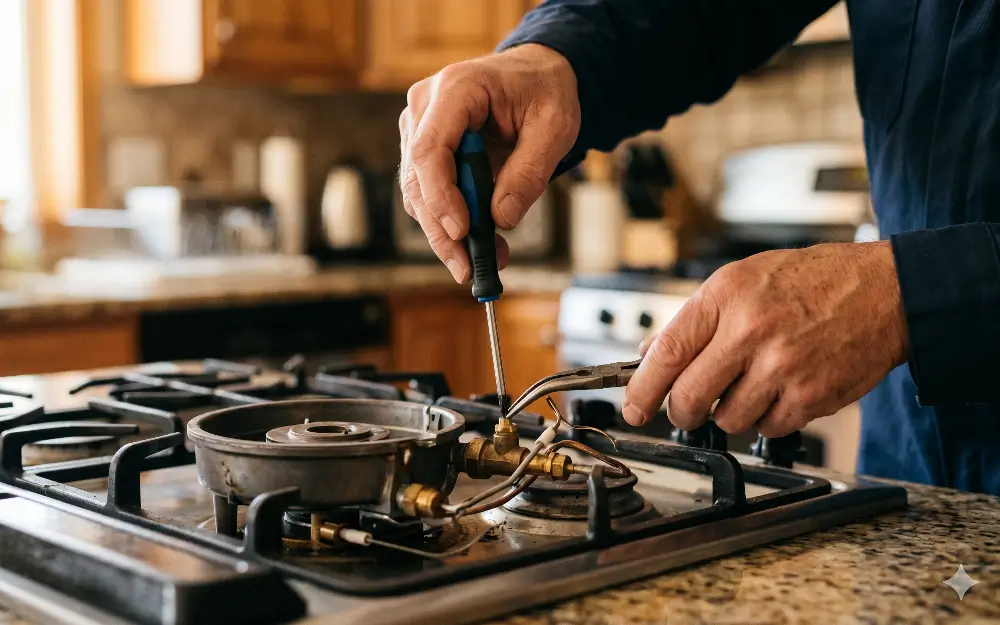
And there is a dangerous shortcut common in the market you should know about: a flame that keeps going out on its own is usually a worn safety sensor (thermocouple) — the correct fix is repairing or replacing it. But some technicians "solve" it differently: they bypass the sensor entirely. The result? The flame stays on, yes — but if it is ever blown out by a draft or boiled-over food, the gas keeps flowing and nothing shuts it off. Our fixed rule: the safety sensor is a red line — repaired or replaced, never removed.
3
Induction and ceramic are another world: diagnosis by measurement on the coils, sensors and board; glass replaced in exact model-specific dimensions; and pan-detection sensors with their own calibration. And since a gas hob sits inside the counter, every leak test we run uses an electronic detector — a leak trapped under marble is one you will not smell in time.
All variants
Every hob type we repair
Whether traditional gas or advanced induction — we have the specialist for every type.
Hob repair guide: your area, your brand, and the fault in one place
Skip the searching: pick your area to find the nearest technician, your brand to see its known faults, or the fault itself to understand the cause before you call. Every link here takes you straight to the page that fits your case.
If you are searching for...
Hob repair near me
Choose your area from the area links to reach the nearest technician.
Hob repair for a specific brand
Choose the brand link to reach the matching service page.
Fault cause before booking
Check the related fault links to identify the likely cause.
Induction is not ceramic is not gas. We have technicians specialized in each technology to guarantee a correct fix on the first visit.
Full transparency
Free inspection and cost disclosed before any repair.
Written warranty
3-month to 1-year warranty + official tax invoice.
Safety sensors are a red line
Thermocouples, heat sensors and pan detection get repaired or replaced — never bypassed "so the appliance works". Your home's safety is not negotiable.
Frequently asked about hob repair
What is the difference between a stove and a hob?
A stove = a hob + an oven in one unit. A hob = just the upper section (the burners) without an oven. Hobs are popular in modern kitchens because they let the oven be installed separately and higher up in the wall — more practical for daily use.
How much does hob repair cost?
The in-home inspection is free. Most hob repairs start from around EGP 800-1,200 (ignition, thermocouple, cleaning and adjustment), while induction and ceramic faults involving boards, coils or glass cost more depending on the part — original ceramic glass or an induction board can run EGP 2,000-4,000 by brand. Figures are approximate and vary with the appliance, its age and condition; the exact price is quoted before any work starts.
The flame lights then dies when I release the knob — what is that?
The most common gas-hob fault, usually the thermocouple (safety sensor): you press the knob and the flame lights, you release it and the flame dies — the sensor isn't detecting heat so it shuts the gas. The fix: cleaning the sensor, adjusting its position, or replacing it. And beware a widespread dangerous "fix": some technicians bypass the sensor entirely — never accept that, because that sensor is what shuts off the gas if the flame is blown out by a draft or boil-over.
My induction hob won't heat the pot — a fault, or the wrong pot?
Try this before calling: take a fridge magnet and hold it to the pot's base. If it doesn't stick, the pot itself isn't induction-compatible — the hob is fine and you need ferromagnetic cookware. If the magnet sticks and the hob still won't heat, then it is a real fault (pan-detection sensor or coil) — call us. This one test saves many people a pointless visit.
Do you repair induction hobs?
Yes. Induction is newer tech and its faults require specialists in precise electronics. We have those specialists.
If the hob glass breaks or cracks, is the glass replaced or the whole appliance?
Usually only the glass is replaced, not the whole appliance — we supply it in the exact model dimensions for common brands, and order rare ones within days. Important: a small crack never stays small — it grows with every heat cycle, and on a working ceramic hob it can shatter suddenly. Stop using the zone above the crack until the glass is replaced.
Is gas-hob service different from induction service?
Very different. Gas hobs are more mechanical (burners, valves). Induction is purely electronic (coils, sensors, board). Each requires a specialist and different tools.
Is an induction hob safe?
Yes — actually safer than gas because there is no open flame. But service must be done by specialists so its many sensors work correctly.
Do you install new hobs?
Yes. Hob installation in the counter needs an expert: correct measurements, safe gas/electrical connections, and proper sealing. See the installation page.
Does an induction hob use a lot of electricity?
The opposite. Induction is 30-40% more energy-efficient than traditional electric because it heats the pot directly with no heat loss. Maintenance preserves that efficiency.
Are hob spare parts more expensive?
Yes, especially for European brands. But hobs typically last longer than a traditional stove because they have no oven (fewer fault points).
Hob broken? Don't wait
Every day of delay can grow the fault and increase the cost. Call now.


 1
1